
What is desk yoga?
Desk yoga is a group of gentle yoga movements adapted for a chair and a small space. Each one mobilises a joint that stays still while you type, usually the neck, shoulders, spine, hips or eyes, and pairs it with slow nasal breathing. It needs no mat, no change of clothes and no prior yoga experience.
It is not a workout. The goal is to interrupt long periods of stillness, restore easy movement to the joints that have stopped moving, and calm the breath that tends to get shallow when you are concentrating hard on a screen.
Why long days at a desk leave you stiff
Sitting is not harmful in itself. The problem is sitting in one position for a long time. Three patterns show up again and again in the desk workers we teach:
- Forward head. As you lean towards the screen, the neck muscles work harder to hold the head up. By mid-afternoon that can feel like a tight band across the upper shoulders.
- Rounded upper back. Arms reaching for a keyboard pull the shoulders forward and the chest in. Breathing moves up into the chest and becomes quicker and shallower.
- Slumped lower back and tight hips. Hours of hip flexion leave the front of the hips short and the lower back unsupported, especially on sofas and soft chairs when working from home.
Eyes follow the same rule. When you focus at one near distance for hours, you blink less and the focusing muscles tire. That is why the routine below ends with the eyes, not just the body.

7 desk yoga stretches for neck, back and eyes
Sit towards the front of a stable chair with both feet flat on the floor and your knees roughly over your ankles. Move slowly, breathe in and out through the nose, and stay within a comfortable range. A stretch should feel like a gentle pull, never a sharp or pinching pain.
Step 1: Seated neck release
5 breaths each sideGreeva sanchalana (side bend)
Sit tall and let your right ear drop towards your right shoulder without lifting the shoulder. Rest your right hand lightly on the left side of your head only if you want a little more stretch. Stay for five slow breaths, then change sides.
Reach the opposite fingertips down towards the floor to feel the stretch travel along the side of the neck.
Step 2: Chin tuck
8 slow repetitionsKeeping your eyes level, glide your chin straight back as if making a double chin, then release. This is a small movement: the head moves back, not down. It resets the forward-head posture that screens encourage.
Do this against the back of a high chair once to feel where the head should sit.
Step 3: Shoulder rolls and blade squeeze
Inhale up, exhale back and downSkandha chakra
Roll both shoulders up towards the ears, back, and down, five times. Then draw the shoulder blades gently towards each other and down, hold for three breaths, and release. Keep the ribs soft so you do not arch the lower back.
Step 4: Seated cat–cow
6 rounds with the breathMarjaryasana–bitilasana (chair variation)
Place your hands on your knees. As you breathe in, lift the chest forward and up and let the lower back curve gently. As you breathe out, round the spine, draw the navel in and let the head drop. Move between the two shapes like a slow wave.
Most people find their lower back loosens more from this than from any single held stretch.
Step 5: Seated twist
5 breaths each sideBharadvajasana (chair variation)
Sit tall. Breathe in to lengthen the spine, then breathe out and turn your chest to the right, holding the back of the chair or your right thigh. Turn from the middle of the back, with the head following last. Stay for five breaths, return to the centre, and change sides.
Grow taller on each in-breath and turn only a little further on each out-breath. Do not wrench yourself round with your arms.
Step 6: Figure-four hip opener
5–8 breaths each sideCross your right ankle over your left knee and let the right knee soften towards the floor. Keep the spine long and, if you want more, hinge forward slightly from the hips. Stay for five to eight breaths and change sides. Skip this one if you have a knee or hip replacement, and use a simple seated forward lean instead.
Step 7: Eye rest: palming and near–far focus
5 breaths, then 10 focus shiftsRub your palms together until warm and cup them over your closed eyes without pressing on the eyeballs. Rest there for five slow breaths. Then look at a fingertip about 20 cm away, then at something at least six metres away, such as a window or the far end of the office. Shift between near and far ten times.
Blink fully a few times afterwards. We tend to blink far less while reading a screen.
A 2-minute routine for every hour
Set a quiet reminder for every 45 to 60 minutes of sitting. When it goes off, do the short sequence below in your chair. Short, regular breaks spread through the day do more for stiffness than one long stretch session after work.
| Time | Movement | What it targets |
|---|---|---|
| 0:00–0:20 | Chin tucks ×5 and shoulder rolls ×5 | Neck and upper shoulders |
| 0:20–0:50 | Seated cat–cow ×4 rounds | Whole spine |
| 0:50–1:20 | Seated twist, 3 breaths each side | Mid-back and ribs |
| 1:20–1:40 | Stand up, reach both arms overhead, 2 breaths | Hips and chest |
| 1:40–2:00 | Look far away out of a window and blink slowly | Eyes |
Standing up for even twenty seconds matters. The World Health Organization recommends limiting the time spent sitting and replacing some of it with movement of any intensity. Taking calls standing up or walking to fill a water bottle both count.
Screen fatigue: rest the eyes, not only the body
Eye doctors often suggest the 20-20-20 rule: every 20 minutes, look at something about 20 feet (six metres) away for 20 seconds. It pairs naturally with the palming and near–far focus practice above. Yoga adds one more idea: let the breath slow down while the eyes rest. A few unhurried breaths with the eyes closed signal to the whole system that the pressure is off for a moment.
For a deeper practice of steady gazing, our teachers use trataka, a traditional concentration technique. It needs guidance on duration and eye comfort, so it is best learned in class rather than from an article.
Making desk yoga a habit, alone or as a team
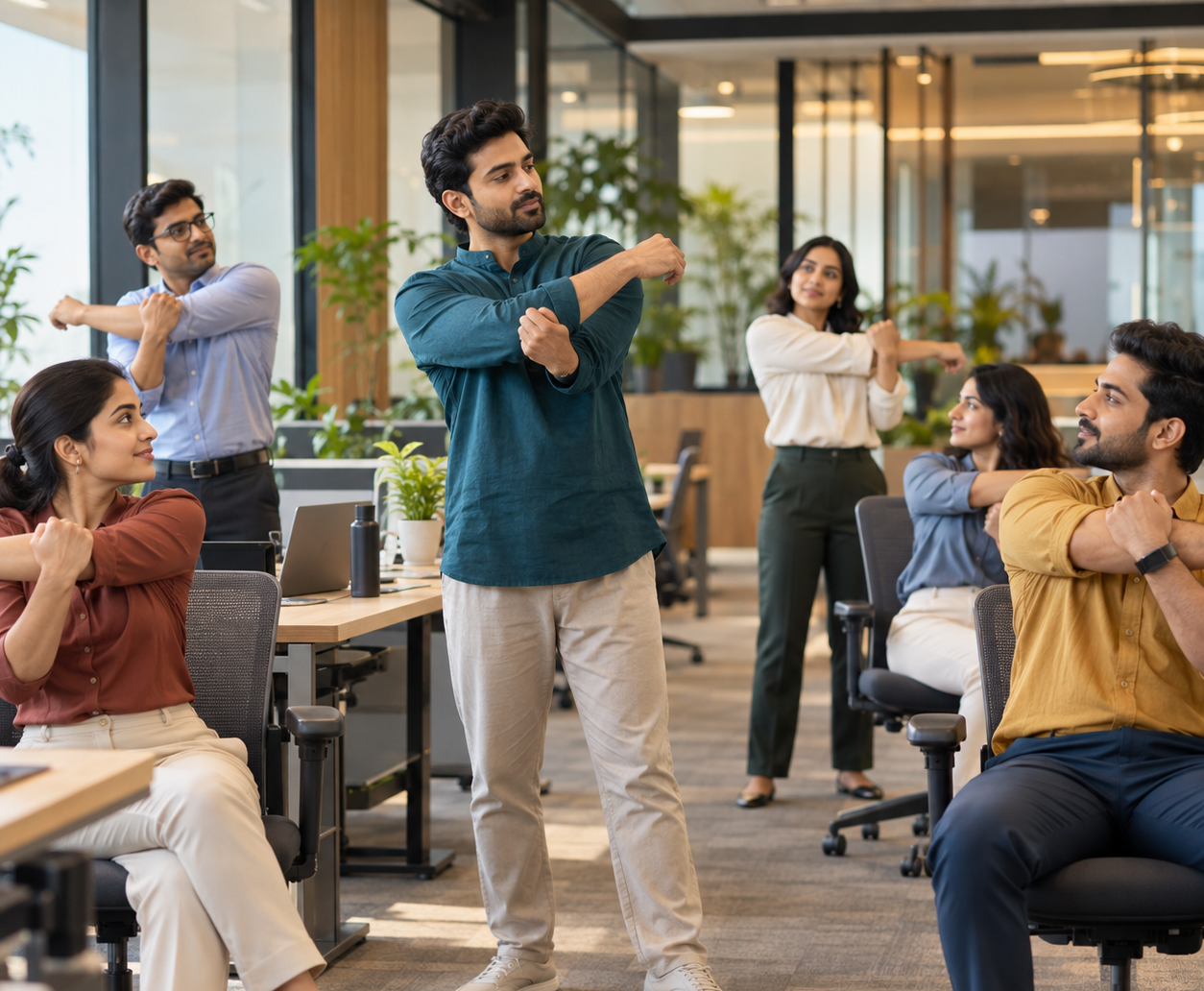
The stretches only help if you actually do them, and at work the hard part is remembering. Tie the routine to something that already happens: the end of every meeting, each time you refill your water bottle, or the moment a build or test run starts. Many of our students keep a sticky note on their monitor for the first two weeks.
Teams find it easier together. A five-minute guided stretch at the start of a stand-up takes almost no time from the day and makes the habit visible. If you want a routine designed around your own posture, work hours and any existing back or neck problems, a few 1-to-1 yoga sessions in Baner or online can set you up with a plan you can repeat on your own.
And if your body is asking for more than a chair allows, a steady full practice builds the strength that makes desk posture easier to hold. Surya Namaskar is a good place to start at home.